OUR CHURCH · ART AND CRAFTSMANSHIP
Inside Our Church: the Art of the Choir Stalls
Behind the high altar, carved wood tells a story of worship, skill and a village’s generosity.
An original community article based on Derek Mercieca’s research, published in the 2018 Tarxien titular feast annual, pages 79–82.
Read Derek Mercieca’s original article ↗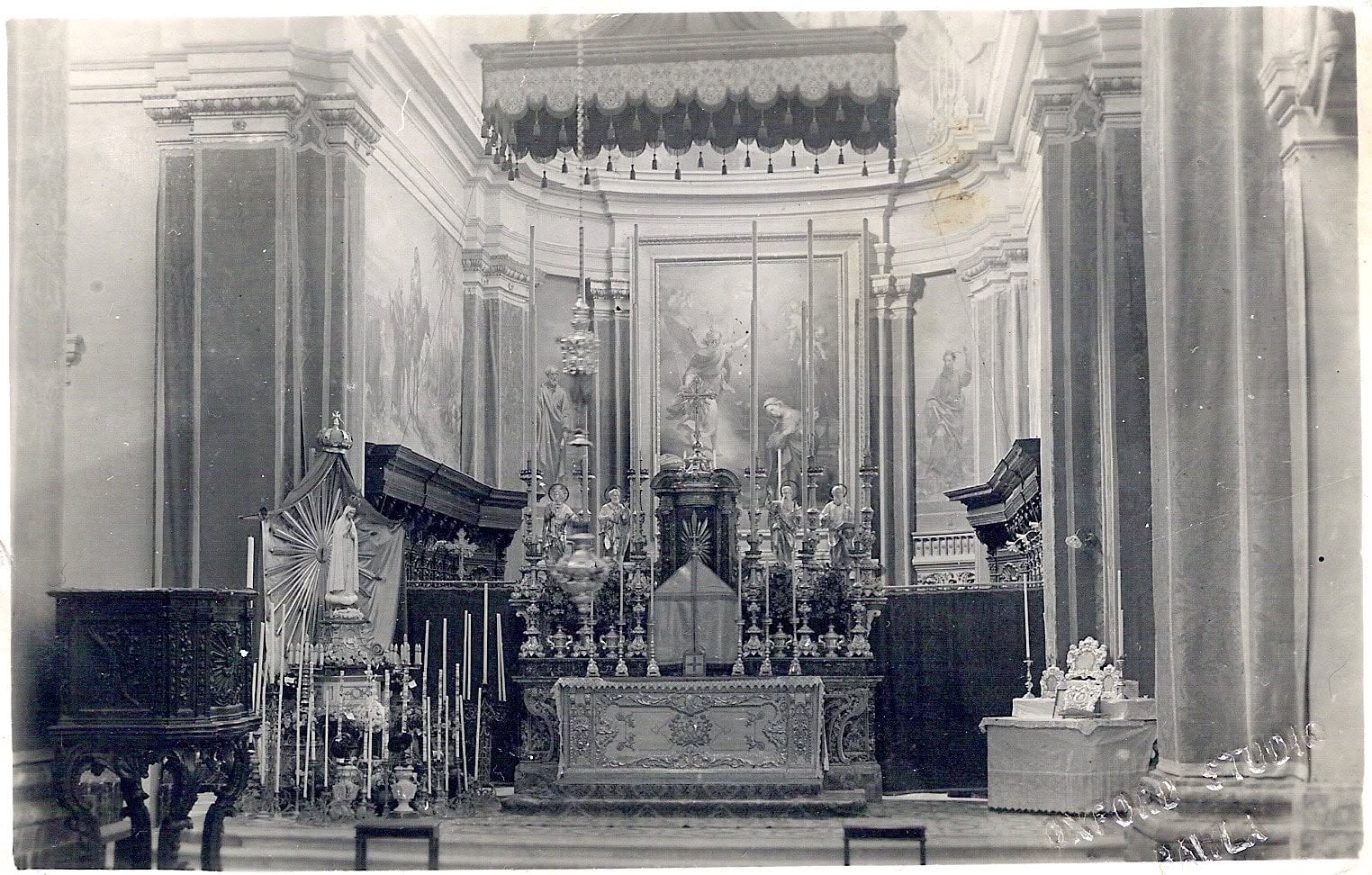
A sanctuary filled with art
The interior of Ħal Tarxien’s Annunciation church rewards a closer look. The high altar and Pietro Gagliardi’s titular painting draw the eye forward, while the lateral paintings by Ġużeppi Calì enrich the surrounding space. Among these works stand the carved wooden choir stalls: furniture made for the liturgy, yet carefully shaped as part of the church’s artistic setting.[p. 79]
The word “choir” here refers to the space associated with the clergy’s liturgical prayer. The stalls provided seating within that space. Their decoration gave dignity to a practical purpose, joining worship and craftsmanship in the same work.
Making room for the choir
Mercieca describes the enlargement of the choir as beginning in 1699 and finishing in 1723. Once the building work was complete, the space needed suitable artistic decoration and furnishings. A carved Maltese stone surround associated with the Żahra family framed the earlier oval titular painting. Pastoral visitation records praised its workmanship; the article notes that this surround was later destroyed in the twentieth century.[p. 79, 82]
The same records reveal why new seating was needed. The earlier arrangement included benches on both sides and a central lectern in poor condition. Vicar General Adriano Gourgion recommended a more appropriate set of stalls, and donations began to give the project financial support.[p. 79–80]
This episode belongs to the church’s later development. Mercieca gives 1627 for completion of the earlier building; other sources discussed on our main history page give 1636. These dates concern the building, while the parish itself was established in 1592.
Antonio Farrugia’s workmanship
Mercieca identifies Antonio Farrugia of Senglea, known in Maltese as l-Isla, as the maker of the stalls. Farrugia also worked on the church’s sacristy cupboards, two large choir candlesticks and the baptismal furnishing. Together these commissions show how a skilled craftsman could contribute to several parts of a church interior.[p. 80]
The design has traditionally been attributed to Francesco Żahra, but Mercieca states that documentary evidence for that attribution had not been found. It is therefore important to distinguish Farrugia’s documented workmanship from the traditional attribution of the design.[p. 80]
A work supported by the community
The article lists early contributions from parish clergy and deacons amounting to 274 scudi. It reports that the stalls were in place by 1752, as described during Bishop Alpheran de Bussan’s visitation. Parish accounts record a payment of 755 scudi for the stalls and sacristy cupboards, with a reproduced entry dated October 1752.[p. 80–81]
The commission was not without difficulty. Mercieca records a legal dispute because the stalls and cupboards had not been completed by 1750. He also identifies a later payment of seven scudi on 23 March 1754 for work on a choir seat. That payment may indicate subsequent adjustments; it does not establish a new construction date for the whole set.[p. 80–81]
Look closely at the Baroque details
The stalls occupy two tiers on each side of the choir. Mercieca counts nine seats per side in the upper tier and six per side below, making thirty seats in total. He describes their timber as injam tal-aħmar. His article places them within the mid-eighteenth-century tradition of Maltese ecclesiastical furniture and compares them with examples in Balzan, Lija and Żejtun.[p. 81]
The decoration is rich in Baroque movement. Medallions shape the backs, with shells above them. Carved arms curl outward, while laurel ornaments enrich the dividing pilasters. A high cornice crowns each side, supported by elegant brackets. These details give the long rows rhythm and depth rather than allowing them to read as plain benches.[p. 81]
Fourteen of the stalls carry a small cross and a Roman numeral, allowing the Stations of the Cross to be followed within the choir. The carving therefore forms part of a devotional setting as well as a decorative one.[p. 81]
What has changed over time
Mercieca explains that the woodwork of the central lectern had been replaced, leaving its ironwork as the original surviving element. He cautions that its former appearance could no longer be established with certainty. The distinction reminds us that a church interior accumulates repairs and alterations, even when its older furnishings remain in use.[p. 81]
The choir stalls preserve more than an attractive style. They connect the parish’s prayer with the makers, donors and generations who cared for its interior. Looking at the shells, curved arms and carefully ordered seats helps us appreciate the human effort behind the church’s heritage.
THE CHOIR THROUGH TIME
A short timeline
- 1699Enlargement of the choir begins.
- 1723Choir enlargement is completed.
- 1750Unfinished stalls and cupboards give rise to a dispute.
- 1752The stalls are recorded in place; an October account entry records payment.
- 1754A further payment for work on a choir seat is recorded on 23 March.
- 2018Derek Mercieca publishes his study of the stalls and their archival history.
Credit and further reading
Derek Mercieca, “Is-sedji tal-kor fil-knisja arċipretali ta’ Ħal Tarxien”, Festa titulari [Marija Annunzjata, Tarxien] 2018, pages 79–82. Published by Għaqda Mużikali Marija Annunzjata, Ħal Tarxien.
This English community article summarises and explains Mercieca’s research. The archival records and historical payments mentioned here are reported through his study; they have not been independently re-examined for this website. The linked original includes photographs of the carving and reproductions of archival records.
Original Maltese article · University of Malta repository ↗